
 09.11.2026
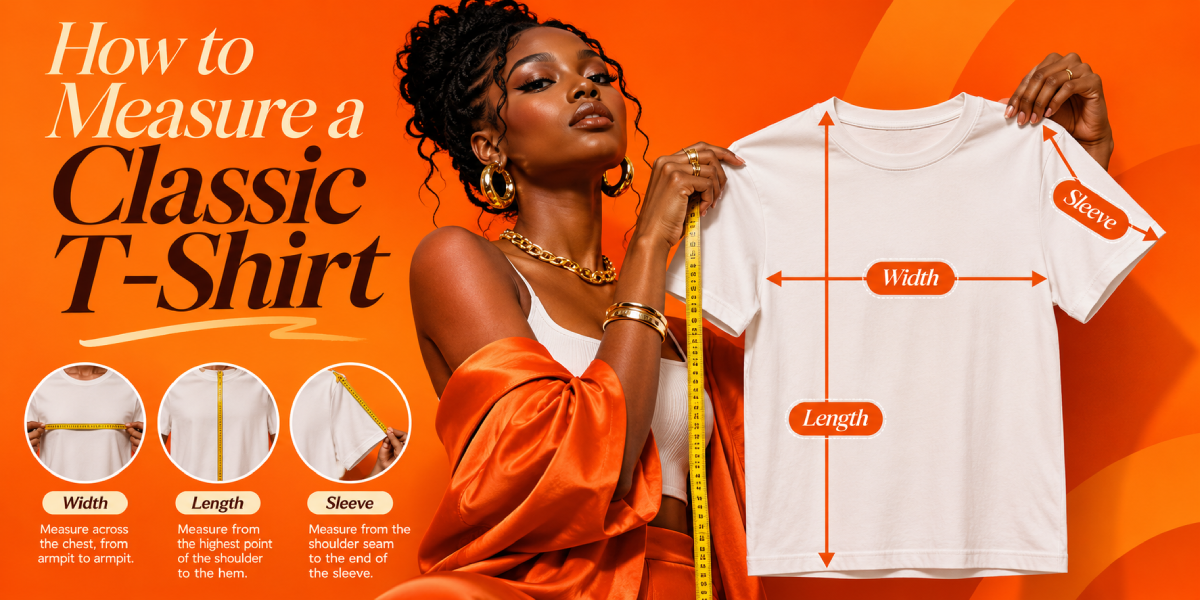
Ever ordered a T-shirt in your usual size only to discover it fits completely differently from the one you already own? You’re not alone. Size labels vary between brands, but a measuring tape gives you something much more reliable: actual measurements.
The easiest way to measure a classic T-shirt is to lay it flat and measure the chest width, body length, shoulder width and sleeves in centimetres. You can then compare those numbers with a product’s size chart before buying.
Here’s exactly how to do it.
What You’ll Need
You only need three things:
- A flexible measuring tape marked in centimetres.
- A flat surface, such as a clean table.
- A classic T-shirt that fits you well and has already been washed according to its care instructions.
Choose a T-shirt with a fit you actually like. Measuring a shirt that is too small or stretched out won’t give you a useful reference.
Step 1: Lay the T-Shirt Flat
Place the T-shirt face up on a flat surface.
Gently smooth out wrinkles and make sure the front and back are aligned. Don’t pull or stretch the fabric.
Check that the shoulders are lying naturally and the side seams aren’t twisted.
Tip: Measure the garment when it’s dry. Wet jersey can stretch under its own weight and give misleading results.
Step 2: Measure the Chest Width
Chest width is one of the most important measurements for choosing the right classic T-shirt size.
- Locate the points just below the armpits.
- Place the measuring tape horizontally across the front of the T-shirt.
- Measure from one side of the garment to the other.
- Keep the tape straight and the fabric relaxed.
For example, if your T-shirt measures 54 cm across the chest, its approximate full chest circumference is 108 cm.
Remember that flat garment chest width is different from your body chest circumference. The T-shirt needs additional space for comfortable movement.
Step 3: Measure the Body Length
Body length determines where the T-shirt hem will sit on your torso.
- Locate the highest shoulder point next to the neckline.
- Measure straight down to the bottom hem.
- Keep the tape following a vertical line without stretching the garment.
If the T-shirt measures 72 cm from shoulder to hem, use that length as a reference when comparing other shirts.
Important: Some brands measure body length from the back of the neck instead. Always check the size chart’s measuring instructions before comparing numbers.
Step 4: Measure the Shoulder Width
Shoulder width helps determine whether a classic T-shirt will sit naturally across your upper body.
- Find the seam where one sleeve joins the shoulder.
- Measure straight across the upper back or front to the equivalent seam on the opposite side.
- Keep the fabric flat and avoid pulling the seams outward.
Classic fit T-shirts generally have shoulder seams near the natural shoulder points rather than deliberately dropped down the arms.
A significant shoulder-width difference can change how the sleeves and upper body fit, even if the chest width is similar.

Step 5: Measure the Sleeve Length
To measure the sleeve length of a standard short-sleeve T-shirt:
- Find the shoulder seam where the sleeve begins.
- Measure along the outer edge of the sleeve to its hem.
- Repeat on the other side if you want to check symmetry.
The sleeve length affects how much of your upper arm is covered. Classic tees usually have a moderate sleeve length, although exact proportions vary by design.
Step 6: Measure the Sleeve Opening
If you’re particular about how T-shirt sleeves fit around your arms, check the sleeve opening too.
Lay the sleeve flat and measure straight across the opening from one edge to the other.
For example, a flat sleeve opening measuring 18 cm has an approximate circumference of 36 cm.
This measurement is especially useful if you prefer sleeves that aren’t too tight or excessively wide.
Classic T-Shirt Measurement Guide
Use this table as a quick reference when measuring your favourite tee.
| Measurement | Where to Measure | Why It Matters |
|---|---|---|
| Chest Width | Armpit to armpit, horizontally | Determines room around the chest |
| Body Length | Highest shoulder point to hem | Helps predict where the hem sits |
| Shoulder Width | Shoulder seam to shoulder seam | Affects upper-body proportions |
| Sleeve Length | Shoulder seam to sleeve hem | Determines arm coverage |
| Sleeve Opening | Straight across the flat sleeve hem | Helps assess sleeve room |
How to Compare Your Measurements With a Size Chart
Once you have your measurements, compare them with the product’s size chart.
But first, check whether the chart shows body measurements or garment measurements.
If it shows garment measurements, you can compare your T-shirt directly with the chart, provided the measuring methods match.
If it shows body measurements, measure around your own chest or bust and use those numbers instead.
Example: If your favourite classic tee is 54 cm wide and 72 cm long, look for a product with similar dimensions if you want a comparable fit.
Remember that fabric stretch, cut and construction can still affect how two shirts feel.
How Much Extra Room Should a Classic T-Shirt Have?
A classic fit should offer comfortable room without looking excessively loose.
The difference between your body circumference and the garment circumference is called ease.
For example:
- Body chest circumference: 100 cm.
- Garment chest circumference: 110 cm.
- Chest ease: 10 cm.
This is an illustrative example, not a universal recommendation. The amount of ease you prefer depends on your body shape, fabric and desired silhouette.
Common T-Shirt Measuring Mistakes
Avoid these problems to get more reliable measurements:
- Stretching the fabric: Let it lie naturally instead.
- Measuring on your body: Garment measurements are best taken with the shirt laid flat.
- Using an uneven surface: A flat table gives more consistent results.
- Confusing width with circumference: Flat chest width is approximately half the full garment circumference.
- Ignoring the measuring method: Different brands may measure length or sleeves differently.
- Measuring a poorly fitting shirt: Use a tee whose fit you actually want to reproduce.
How to Measure Women’s Classic T-Shirts
The measuring method is the same for women’s classic T-shirts: lay the garment flat and check chest width, body length, shoulders and sleeves.
If the T-shirt has a shaped waist, measuring the width at the narrowest point can also be useful.
Explore our women’s classic T-shirts and compare the individual product measurements with a tee you already enjoy wearing.
How to Measure Men’s Classic T-Shirts
For men’s classic T-shirts, chest width and body length are useful starting points, followed by shoulder width and sleeve measurements.
A traditional classic fit usually has a relatively straight body and shoulder seams positioned near the natural shoulders.
Browse our men’s classic T-shirts and use the garment dimensions to find the proportions you prefer.
Quick Answer: How to Measure a Classic T-Shirt
To measure a classic T-shirt, lay it flat without stretching the fabric. Measure the chest from armpit to armpit, the body length from the highest shoulder point to the hem, the shoulder width between the shoulder seams and the sleeve length from shoulder seam to sleeve hem.
Record everything in centimetres and compare the numbers with the product’s garment size chart.
The golden rule: Measure a T-shirt that already fits you well. It gives you a much more useful starting point than relying on S, M, L or XL alone.






















Leave a Reply